I forgot when I started to draw my first mind maps.
Like I'm sure many others do, I'm thinking slightly chaotic, in the sense, that I get inspiration and ideas after I finished something.
Mind maps are, as far as I know, created for that kind of thinking. So - if you're not one of those rare and rather strange persons who thinks everything sequentially and forward, you'd benefit from it too.
My preference tool is paper and pencil. Yes, I'm bloody old fashioned, but that always works and batteries don't wear out.
However, sometimes it's practical to have stuff on a computer and I've been using
FreeMind for years. It's free, it's easy to use and though it's got its fair amount of really hilarious bugs, it's stable and reliable.
So - Paul Carvalho inspired me to write about how I use FreeMind to organise test ideas. I can't show you examples from real life, as they would both be way too big to show and I guess my clients would
mind if I
map their business (
pun intended...).
Of course I would never reveal that, but I am willing to reveal a mockup example to show how I do it.
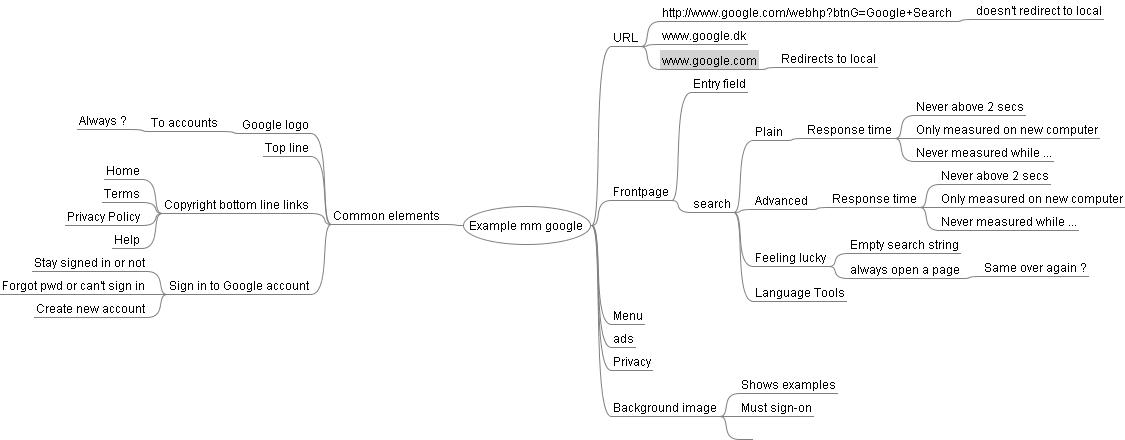
Here's an example we all know: Google. I only used the front page and followed a few links.
You may recognize that I 'factored' the front page. We all know it as a simple text field and a search button. Most of us remember that there's also an 'I feel lucky'-button, that we only use when we're bored. But in fact there's quite a lot of other features, and they are a bit more advanced than it looks like. For instance the redirection function that shows you a localized front page.
Take a look at the real thing and compare with my little mind map here.
Factoring is a skill of it's own, I learned it from James Bach. Factoring is really about finding 'dimensions' to test. Here I just put in the functions I found, but I did make a note that there's performance in a search operation. I put it in and maybe I want to later expand that node.
Notice I reused the response time sub-tree for the advanced search as well. Is that good organizing ? Well, it's okay for a preliminary stage. But later - if we get to reuse it a lot, it's better to move it out among the common elements or something and simply refer to it. The good thing is that there are no rules. Whatever works for you - well, it works for you.
One note of warning though: if you fall into the same trap as PM's do when they repeat a block of activities in their plan - you'll get lost. Don't do that. I find that it's mostly not only convenient but also sufficient that you realise that something is repeating. There's little value in documenting everything. The real value comes from you having learned about the repetition.
So - start it up. Extend and expand as you get more information and inspiration. Extend and reuse by referring. Use icons to add some meaning or overview. Ask questions (very easy this way because you always ask the question in context of a node).
I can test directly from this and extend it while I do so. I put in ideas, functions and non-functions to look out for. A map of the system.
I can mark out branches and sub branches and put them on charters. I can readily show what works and where the problems (bugs) are. I can also show what isn't tested yet.
In short - I can communicate this and keep a great overview.
You should try it too.
Please let me know what you think.